GoPro Mission 1
Expert Reviews


User Reviews


Video Reviews

GoPro Mission 1 Review After 2 Months: The Good and the Bad
Here are the main takeaways from the video:
- The GoPro Mission 1 Pro is the action camera to beat in 2026, offering superior image quality compared to other action cameras on the market.
- The camera features a new 1-inch sensor, enabling 8k 60fps recording with incredible detail and a flat color profile (GoPro Log 2) with up to 14 stops of dynamic range.
- The Mission 1 Pro offers high bit rates (up to 240mbps by default, and up to 300mbps with Labs), resulting in exceptional image quality, especially in fast-moving scenes.
- The camera excels in slow-motion, with 4k 240fps and 1080p 960fps recording capabilities.
- The Mission 1 Pro's photo quality is also significantly improved, offering up to 50MP stills and HDR capabilities.
- The camera features a max field of view of 156 degrees, the widest available on an action camera.
- Low-light performance has been significantly improved with the new 1-inch sensor, providing usable low-light footage in ambient light.
- Battery life and overheating issues have been largely resolved, with the Enduro 2 batteries providing longer running times and faster charging.
- The Mission 1 Pro allows for direct connection of USB-C compatible microphones without the need for an extra receiver.
- Downsides include the lack of compatibility with previous GoPro accessories, no internal memory, and a high price tag.
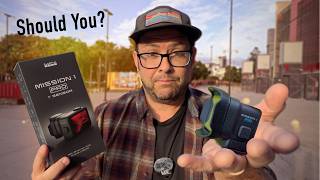
The $700 GoPro! Mission 1 Pro, is it for Normal People???
Here are the key takeaways from the video:
- GoPro Mission 1 Pro: A compact cinema camera priced at around $700, featuring an 8K resolution, 1-inch sensor, and water-resistance up to 60 feet.
- Cinematic Potential: Positioned as a cinema camera with hardware improvements rather than just an action camera, catering to content creators and vloggers.
- Low Light Performance: The 1-inch sensor significantly improves low-light recording, addressing a common weakness in previous GoPro models.
- 8K Open Gate Video: Allows recording in a boxy 4:3 aspect ratio using the full sensor, making it easier to crop for 16:9 or vertical formats.
- Audio Quality: Features 32-bit float internal microphones, preventing audio clipping even when loud sounds are recorded.
- Target Audience: Ideal for content creators and solo vloggers looking for a cinematic B-roll camera, though potentially overkill for casual users.

GoPro Mission 1 Pro - Action and Vlogging Cam Test & Review
Here are the main takeaways from the video:
- The GoPro Mission 1 Pro is a versatile action camera designed for activities such as mountain biking, vlogging, and more.
- It features 8K30fps resolution, true 4:3 open gate shooting, 10-bit color, GP-Log2, and 32-bit float audio capabilities.
- The camera's build quality is robust, coming with a cage and grip setup that provides an ergonomic feel, similar to traditional cameras.
- The camera performed well in mountain biking, vlogging, and a stress test (running a mountain marathon), capturing stable footage with a wide field of view.
- The camera's menu system is user-friendly and allows for quick toggling between different modes and settings, which is useful in fast-paced scenarios.
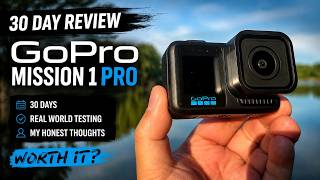
I Used the GoPro Mission 1 Pro for 30 Days. Here's What I Think
Here are the main takeaways from the video:
- Significantly Improved Video Quality and Low Light Performance: The GoPro Mission 1 Pro features a new 1-inch sensor, GP3 processor, and dedicated night mode, which dramatically improves low-light shots compared to previous GoPro models. This makes it much more capable for filming in suboptimal lighting conditions like twilight, sunset, or under tree canopies.
- 8K Capture Capability: Both the standard Mission 1 and Mission 1 Pro offer 8K footage, with the Pro model capable of 8K at 60 frames per second. This higher resolution and bit rate (up to 240 Mbps) provide greater flexibility for cropping, zooming, and post-editing.
- Upgraded Enduro 2 Battery: The new Enduro 2 battery significantly increases recording times (up to 5 hours in 1080p and 3 hours in 4K) and supports quick charging (0 to 80% in about 20 minutes). It is also backward compatible with the Hero 13 Black.
- Enhanced Design and Usability: The camera is slightly larger and heavier than the Hero 13 Black, but features larger buttons for easier operation (especially with gloves), a built-in water-pressure-equalizing opening for deeper waterproof depths without a casing (up to 20 meters), an additional microphone on the back for improved audio recording, and a flicker-detection sensor for indoor lighting.
- Overhauled Menu System: The user interface has been completely redesigned with easily swipeable, customizable modes (including new Sport POV, Subject Tracking, Vlogging, and Dive modes), making it faster and more intuitive to navigate.
- Direct USB-C Audio Connection: The Mission 1 Pro now allows direct connection of USB-C microphones and wireless receivers without needing a media mod or adapter.
- Drawbacks:
- High Price: The GoPro Mission 1 Pro is relatively expensive compared to competitors like DJI and Insta360, which often offer similar capabilities at a lower price point.
- Incompatibility with Older Accessories: Due to the new form factor, previous accessories such as cases, frames, ND filters, and wide-angle lenses (like the Hero 13 Black's) are not compatible with the Mission 1 Pro.

GoPro Mission 1: One Month Later Honest Review
Here are the main takeaways from the video:
- Image Quality & Colors: The GoPro Mission 1 delivers natural-looking images without over-saturation. If you prefer a punchier look, the Ace Pro 2 and DJI Action 6 might be better choices. Post-processing can help achieve a similar look across all three cameras.
- Log Profile (GP-Log 2): GP-Log 2 provides a flat profile for grading. Abe Kislievitz's launch LUT helps achieve a cinematic look, but fine-tuning exposure and contrast is required. Black-and-white outputs using TRI-X 400 LUT look impressive.
- Photo Performance: The Mission 1 performs well for closer subjects but struggles with distance and a minimum focus range of 60 cm. Shooting in RAW with low sharpness and no noise reduction is recommended for zooming in.
- Auto ISO and Exposure Monitoring: Auto ISO is crucial due to the lack of manual controls. The Mission 1 is less sensitive to lighting changes compared to the DJI Action 6, resulting in slower adjustments. The front screen makes gauging exposure difficult, and there is no preview LUT.
- Durability and Build: The Mission 1 is heavier and larger than the Action 6, which can be noticeable when mounted on a helmet. However, its durability is a major selling point, surviving drops better than the Insta360 Luna Ultra.
- Battery Life: The Mission 1 has a larger battery than the Hero 13, but shorter runtime compared to the Action 6. Bringing spares is recommended for full-day shoots.
- Audio: The internal audio offers 32-bit float, helping with clipping, but is not ideal for spoken dialogue. Ambient sound capture is strong, though it lacks multi-transmitter support found in other models.
- Slow Motion: The Mission 1 supports up to 4K 120fps, which is standard for the industry.
- Accessories: PGYTECH offers useful accessories like the Caplock action camera handlebar mount and Mantis Pod Z grip, which enhance stability and ease of use.

GoPro MISSION 1 PRO: A Pocket Cinema Camera?
Here are the main takeaways from the video:
- GoPro Mission 1 Pro Overview: GoPro's new Mission 1 Pro is a departure from traditional action cameras, focusing on image quality and flexibility. It features a new 1-inch quad-bearing sensor with up to 14 stops of dynamic range, powered by a new GP3 processor.
- Video and Audio Capabilities: The camera can shoot open gate at 8K, with up to 240 frames per second in 4K and 960 frames per second in 1080p. It includes four microphones and a new wireless mic system for improved audio quality.
- Design and Battery Life: The Mission 1 Pro has a beefier design with a larger rear LCD and redesigned, more tactile buttons. Battery life is improved with the Enduro 2 battery, offering longer runtimes and fast charging.
- Perspective and Future Expectations: The camera feels closer to a compact cinema camera than a traditional action camera. Future iterations with interchangeable lenses are anticipated.

GoPro MISSION 1 Pro - 2 WEEKS LATER!
Here are the main takeaways from the video:
-
Key Insights:
- The GoPro Mission 1 Pro excels in image quality, battery life, resolution, and slow-motion capabilities.
- It features impressive color profiles, notably the natural color profile and the new GP Log 2, offering a flat profile for color grading.
- The GP3 processor enhances image quality and battery life, preventing overheating even under harsh conditions.
- The Enduro 2 battery allows for longer recording times and supports quick charge.
- The camera's cinema cage and burst video mode (up to 960 frames per second) are standout features.
- Subject tracking is superior to DJI's, retaining 4K resolution and working horizontally and vertically.
-
Actionable Advice:
- Consider the GoPro Mission 1 Pro for high-quality action and sports filming, particularly for self-improvement in sports like tennis.
- Utilize the GP Log 2 for advanced color grading in post-production.
- Be mindful of the lack of internal storage; a micro SD card is necessary.
-
Unique Perspectives:
- Despite its high price point ($700), the camera is considered a top-tier standalone action camera, though it lacks hyperview found in other GoPro models.

I Wanted to Love the GoPro Mission 1 Pro... But I Can't
Here are the key takeaways from the video:
-
New GoPro Mission 1 Pro Camera:
- Features a 1-inch sensor, 8K at 60fps, 4K at 240fps, and super slow motion at 960fps (1080p, 10-second bursts).
- Offers 10-bit color, GP-Log 2, and a max video bitrate of 240 Mbps.
- Three lens modes: SuperView, Wide, and Linear.
- Advanced video stabilization: HyperSmooth and Horizon 360 Lock.
- Marketed as a "compact cinema camera" rather than just an action camera, priced at $700.
-
Image Quality & Color Grading:
- The 1-inch sensor provides greater dynamic range and information in highlights and shadows compared to competitors like the DJI Action 6.
- Skin tones appear more natural, and the footage is flexible for color grading in post-production.
-
Artlist Sponsorship & AI Tools:
- Artlist offers royalty-free music, sound effects, stock footage, and AI tools for video generation.
- Includes Gemini Omni Flash, an AI model for conversational video generation and brainstorming.
- AI apps allow for tasks like generating multiple locations from a single image or creating AI-powered drone shots.
-
Drawbacks & Considerations:
- Fixed Focus: The camera struggles with vlogging because the focus is fixed, resulting in the background being in focus rather than the creator's face.
- Pricing: At $700, it is expensive for an action camera and doesn't offer the same versatility as a mirrorless camera.
- Pole Visibility: The selfie stick or pole can still appear in shots, which can be a drawback compared to cameras like the Insta360 X5.

GoPro Mission 1 Pro In-Depth Review: 61 Things You Need to Know!

GoPro Mission 1 Pro vs GoPro HERO13 Black | Worth the Upgrade?
Description
A high-performance cinematic action camera featuring a massive 1-inch 50MP sensor and the next-generation GP3 processor, designed for professional-grade resolution and superior low-light performance while maintaining rugged durability.
Highlights
- 50-megapixel 1-inch CMOS sensor
- 8K30 and 4K120 cinematic video capture
- Next-generation GP3 processor for enhanced thermal management
- Internal waterproofing up to 20 meters (66 feet) without a housing
- New Enduro 2 battery system providing up to 5 hours of runtime
- GP-Log2 10-bit color for professional post-production workflows
Specifications
| video resolution max | 8K30 |
| sensor size | 1 inch |
| water resistance (IP rating) | IPX8 |
| water depth (meters) | 20 |
| battery life (video recording hours) | 5 |
| weight (grams) | 207 |
| image stabilization type | electronic |
| field of view (degrees) | 159 |
| connectivity | Wi-Fi, Bluetooth, USB-C (Direct Audio Support) |
| dimensions (LxWxH in cm) | 7.5 x 5.2 x 3.4 |
| horizon leveling (yes/no) | yes |
| slow motion frame rate (fps) | 240 |
| video LOG support (yes/no) | yes |
| removable battery (yes/no) | yes |
| removable lens cover (yes/no) | yes |
| built-in memory (GB) | 0 |
Pros and Cons
Pros
- Large 1-inch sensor delivers best-in-class low-light quality
- High-resolution 8K video offers significant cropping flexibility
- Impressive 5-hour battery life outshines previous Hero models
- Built-in 20m waterproofing is deeper than standard action cameras
Cons
- Noticeably heavier and larger than the Hero series cameras
- Premium price point makes it an expensive entry for casual users
- Large 8K files require high-performance, high-capacity microSD cards
Discussion
No discussions yet
Be the first to share your thoughts!